The Context Gap
A Silent Killer of AI Projects
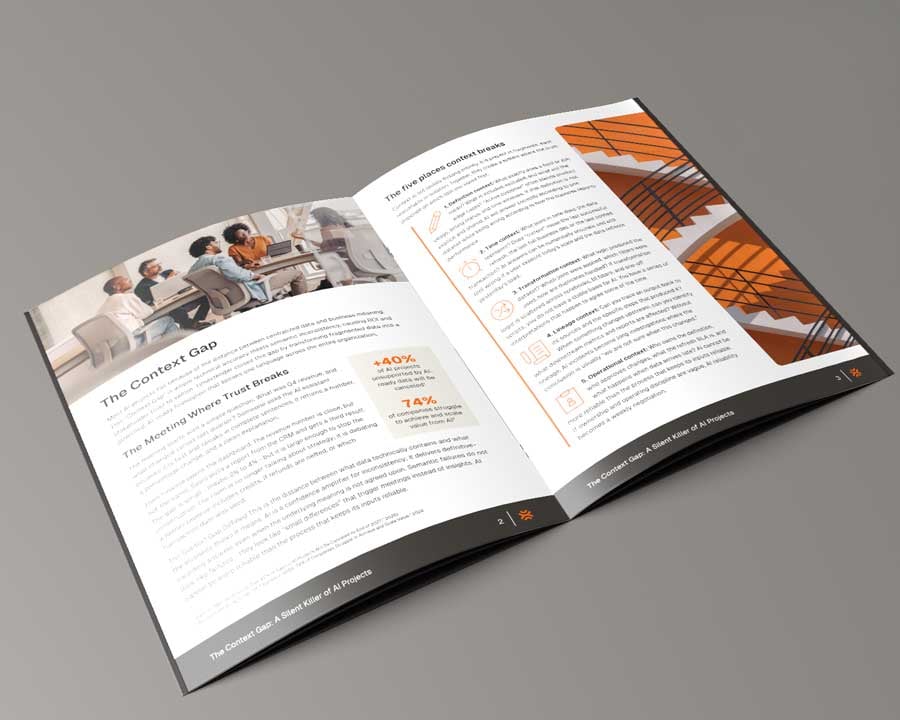
Your AI gave a fast, confident, complete-sentence answer. Then Finance opened the dashboard and got a different number. Sales pulled the CRM and got a third. The gap was 2–4% — small enough to look like rounding, large enough to end the meeting. That's not a model failure. It's a foundation that never agreed on what "revenue" means.
Most teams are debugging the wrong layer
When an AI answer feels off, the instinct is to blame the model — tune the prompt, swap providers, add guardrails. None of that reaches the actual fault line. The model didn't hallucinate; it answered correctly according to whichever definition of "revenue" or "active customer" it happened to be given.
Fix the model and the next AI tool you plug in inherits the exact same disagreement. The fault sits underneath, in data that was never governed to mean one thing.
Turn "trust me" into "trace it"
The whitepaper doesn't tell you AI needs good data; you know that. It gives you the specific, checkable places context breaks, and what closing them actually looks like.
Where semantic disagreement actually hides
A 10-question diagnostic to score your own environment
How to ground AI tools in your approved definitions, not their own guesses
What a governed foundation looks like in practice
Pandora unified data from 5 ERPs and 20+ retail sources into one governed foundation — and cut data preparation time by 80%. Read the full story →
About Timextender
Timextender offers the Timextender Data Platform, a unified platform with four modules: Data Integration, Data Enrichment, Data Quality, and Orchestration. The modules operate independently today as standalone products, and we are actively unifying them into a cohesive web app, eventually connected by shared metadata across the platform.
Timextender helps teams build AI-ready data using metadata-driven automation across any data source, while supporting deployment across cloud, hybrid, or on-prem environments.