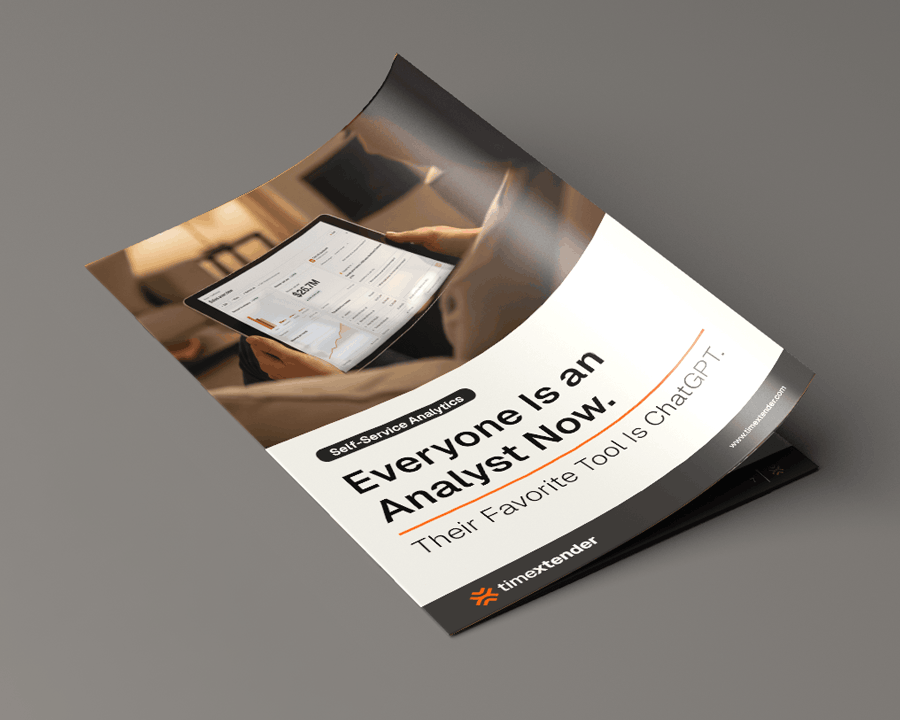
Everyone Is an Analyst Now.
Their Favorite Tool Is ChatGPT.
Business users already analyze data in AI assistants. Make sure the answers use definitions your team owns.
of business users reach for ChatGPT, Claude, Gemini, or Copilot before any other tool for analytical work.
Source: Databox, June 2026, survey of more than 100 business users
fully trust AI for the analysis they share with leadership. They use it anyway.
Source: Databox, June 2026, survey of more than 100 business users
of data practitioners and leaders are concerned about incorrect data reaching stakeholders.
Source: dbt Labs, 2026 State of Analytics Engineering, 363 respondents
Your Self-Service Program Has a New Competitor
Self-service analytics used to be a program with a sponsor, a budget, and a launch date. Today it is whatever tool the person already has open. A sales manager exports a pipeline report, drops it into an assistant, and has a chart in under a minute. The answer reads well. What nobody can say is which definition of revenue it used, which date it counted, or whether it saw the whole customer list. When that number does not match the dashboard, the question lands on your team. This guide covers what to do about it.
What You'll Find Inside
Why self-service now starts in a chat window, and what the surveys say about how business users trust it
The active-customers test: one question, three exports, three confident answers
Why banning the tools, building more dashboards, and pointing AI at raw tables each fall short
Four principles for owning what the numbers mean: define once, make every answer traceable, meet people where they ask, and certify the answers they keep coming back to
A four-week plan, starting with a known-answer test you can run this week without buying anything
How Xpilot Analytics and the Timextender MCP Server meet the four principles
Written for the People Who Own the Numbers
Built for heads of analytics, BI leads, and data and analytics directors who answer for the numbers leadership sees. It names the problem plainly and ends with a four-week plan.
About Timextender
Timextender offers the Timextender Data Platform, a unified platform with four modules: Data Integration, Data Enrichment, Data Quality, and Orchestration. The modules operate independently today as standalone products, and we are actively unifying them into a cohesive web app, eventually connected by shared metadata across the platform.
Timextender helps teams build AI-ready data using metadata-driven automation across any data source, while supporting deployment across cloud, hybrid, or on-prem environments.