




 Aijaz Ansari
 Alex van Wijnen

Most people still frame sovereignty as a question of geography, or of which vendor you sign with. That framing is running out of road. What it comes down to now is control, portability, and keeping the freedom to put each workload where it belongs.
Sovereignty is one of the biggest conversations in enterprise technology right now, and one of the easiest to flatten into a single question: where is the data stored? Is it in the EU, the UK, the US, Germany, France, the Netherlands, Denmark, somewhere else on an approved list? That question still matters. It just no longer covers much of what keeps leaders up at night.
What sovereignty is turning into is a broader question of control. Control over the data, yes, but also over how that data gets processed, how dependent you are on any one piece of infrastructure, where your business logic lives, how AI touches your information, and whether you can pick up and move when you need to.
This isn’t a Europe-versus-US argument, and it certainly isn’t a rejection of hyperscalers, public cloud, or global innovation. The cloud gave us extraordinary scale, security, resilience, and speed, and AI is pushing all of that further.
But the same scale that makes cloud and AI so powerful also makes them systemically important. Once the world’s data, workloads, decisions, and model interactions run through a handful of platforms, boards, regulators, and customers start asking a harder question:
Who controls the critical layers of the digital economy?
That question won’t stay in one jurisdiction. Europe is moving first in places, but you can already hear versions of it in the UK, the US, and other major markets. The answers will look different from one region to the next. The trajectory won’t. Sovereignty is shifting from a compliance checkbox to an architectural principle.
Sovereignty is not one thing
There’s no single definition, and pretending there is one is where most of these conversations go wrong. For one company, sovereignty means the data never leaves a particular legal jurisdiction. For another, it’s about who runs the cloud region and whose hands are on the systems. A third needs certain workloads on-premises because nothing else will pass review. A fourth is mostly worried about whether an AI provider is quietly holding on to its prompts, queries, metadata, or outputs.
None of those is right or wrong on its own. The correct definition depends on the business you’re in, the sector, your risk appetite, who your customers are, and what your regulators expect:
-
A manufacturer modernising its analytics probably needs to move fluidly between on-premises and cloud.
-
A bank needs harder evidence around lineage, quality, and access.
-
A hospital cares about exactly where sensitive data gets processed.
-
A public body may need assurance not just about where data sits, but about who operates the systems and how exposed it is to a single supplier.
The job was never to hand everyone the same standard. It’s to give leadership enough control to set its own.
Data residency is only the starting point
For many years, sovereignty was discussed mainly through the lens of residency. Where does the data live?
That is still an important question, but the more strategic question is dependency:
-
Can the organisation move if regulation changes?
-
Can it shift workloads if customer requirements change?
-
Can it exit if commercial terms change?
-
Can it prove what happened if an auditor, regulator, or enterprise customer asks?
-
Can it separate its business logic from the underlying platform?
-
Can it preserve continuity if a provider, region, model, or service becomes unavailable or unsuitable?
This is why portability belongs at the centre of the sovereignty conversation.
In June 2026, the European Commission reached a preliminary position that AWS and Microsoft Azure should be designated as gatekeepers under the Digital Markets Act for their cloud services. The interesting part is that neither one met the DMA’s quantitative thresholds. The Commission got there on a qualitative read of how central they’ve become and how entrenched they are, with the way AI deepens that dependency doing a lot of the work in the reasoning. Cloud concentration, in other words, is now being treated as a systemic dependency problem rather than a procurement decision. Portability and interoperability are starting to look less like nice-to-have architecture choices and more like conditions a regulator can enforce, especially as cloud becomes critical infrastructure for AI and for everything sitting on top of it.
None of this means European regulators want off American technology. That reading is too narrow, and honestly too political. The real point is simpler. Cloud has become important enough that exit, interoperability, resilience, and dependency are now fair governance questions, and that logic travels.
The US may frame it through competition, national security, critical infrastructure, procurement standards, sector regulation, or AI risk management. The UK may frame it through pro-innovation regulation, data access, public sector AI guidance, and sector-specific controls. The EU may frame it through the EU AI Act, data strategy, digital markets, and sovereign cloud. Other regions will create their own vocabulary but the same underlying question.
How much control does a business, a government, or a regulated sector need to keep over the systems that process and move its most important data?
On-prem, hybrid, and cloud are all part of the answer
A lot of these debates get stuck in false choices.
-
Cloud or on-premises.
-
Hyperscaler or local provider.
-
Public or private.
-
Innovation or control.
That whole framing is out of date.
For most organisations, the answer isn’t a single deployment model. It’s a deliberate mix across on-premises, hybrid, public cloud, and sovereign or regional options. Public cloud will keep being the right home for plenty of workloads, because the scale, resilience, managed services, and fast access to advanced AI are genuine advantages. On-premises still earns its place wherever you need direct control over infrastructure, connectivity, or particularly sensitive work. Hybrid tends to become the practical middle for a lot of enterprises: modernise where it helps, keep some things close, push others to the cloud, and reach for regional or sovereign options when the risk profile calls for it.
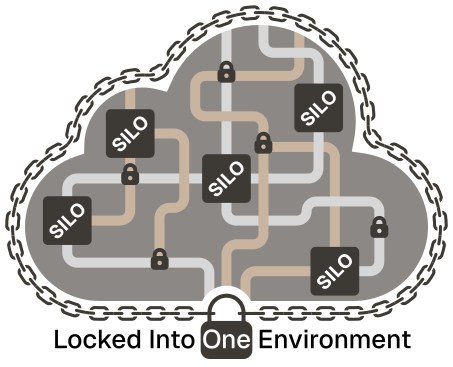
So, the leadership question was never really “which deployment model counts as sovereign?” It’s “do we have the freedom to choose the right one for each workload?”
That is why portability matters.
If a workload can only live in one environment, sovereignty is limited.
If business logic is trapped inside a proprietary service, sovereignty is limited.
If lineage, quality rules, documentation, and governance cannot move with the workload, sovereignty is limited.
If AI interaction depends on one model, one provider, or one set of retention terms, sovereignty is limited.
True sovereignty is not anti-cloud.
It is anti-dependency without choice.
AI governance expands the sovereignty perimeter
AI widens the conversation because it widens what you have to govern in the first place.
Traditional analytics kept you worried about storage, movement, access, reporting, and audit trails. AI drags in a longer list: prompts, embeddings, model calls, outputs, agents, evaluations, and all the context feeding the answers.
-
A prompt can carry confidential information.
-
A query can expose customer data, or how you make money.
-
An output can steer a decision.
-
An agent can go off and do something.
Any one of those interactions can end up as part of the operational record.
Which means sovereignty stopped being only about data at rest or data in motion. It now covers data in use, data in context, and data in conversation with a model. Where those exchanges happen, and whether anything gets retained, is an architecture decision now, not a line in a policy document. That’s the real shift. AI governance won’t stay a policy topic for long. It becomes an architecture topic.

The EU AI Act is the clearest example so far. It sets up a risk-based framework and puts heavier obligations on high-risk uses: data governance, documentation, logging, transparency, human oversight, robustness, accuracy, security. Article 10 is about the data itself for high-risk systems, its quality, relevance, representativeness, and completeness across training, validation, and testing. Article 12 says those systems must support automatic record-keeping across their whole lifecycle. A lot of that evidence - the lineage, the documentation, the quality controls - can fall out of a governed data foundation as a by-product rather than becoming its own painful project.
If you want to see what the Act really asks of your data, this data-readiness guide is a sensible place to start.
And it isn’t only Europe. NIST’s AI Risk Management Framework in the US isn’t a law and isn’t the same instrument, but it points the same way: AI risk must be governed, measured, and made trustworthy in practice, not just written up nicely. The OECD AI Principles say much the same, with dozens of countries signed on to the idea of trustworthy AI grounded in rights and real governance. So, the question isn’t whether every market copies the EU AI Act. Most won’t. The question is whether the big markets start demanding more evidence, more transparency, more accountability, and more control over how AI touches data. They almost certainly will.
The next wave will be regional, sectoral, and contractual
The next phase won’t arrive as one global law. It’ll come in pieces: regional rules, sector expectations, procurement requirements, customer contracts, insurance terms, security reviews, board risk mandates. In Europe, the AI Act, digital markets regulation, the data strategy, and sovereign-cloud efforts are already pushing everyone toward evidence, portability, and controlling dependency. If you must explain all that to a board, an executive guide to the EU AI Act is a good starting brief.
Germany and France carry a sharper edge here, because of their public sector, their regulated industries, and their expectations around trusted cloud. In the Nordics and Benelux,We’d expect the same questions to get louder as buyers in manufacturing, public sector, financial services, energy, healthcare, and critical infrastructure work out how much control they really need over data processing and AI. That’s an inference on my part, but it fits the wider European pattern.
We run into this directly in the field. A German manufacturer we worked with needed zero internet information sharing, no exceptions. The team ended up building a dedicated proxy so their systems never touched the open internet. The cloud wasn’t the gap. The requirement was proof: the board needed a way to show, not just claim, that nothing left the building. That’s the sovereignty conversation we are hearing right now. Buyers rarely ask if they can use the cloud. They ask whether they can prove they stayed in control of it.
The UK is taking a different line. It has leaned into a more pro-innovation approach to AI regulation while still moving on data protection and privacy through the Data (Use and Access) Act 2025, and its public sector AI guidance sets out principles for safe and responsible use inside government. In the US, the vocabulary tends to be less about sovereignty and more about AI risk, critical infrastructure, competition, cybersecurity, procurement, consumer protection, and sector rules. Even so, the EU AI Act reaches across the Atlantic any time a US company’s systems touch the EU market. The practical effect lands in the same place. You will have to prove your data, your models, and your automated decisions are governed.
This is why the whole thing needs lifting above regional politics. It was never really about whether one region trusts another. It’s that data and AI systems now move and process information at a scale big enough to move markets, affect citizens, and touch national infrastructure. Governance follows capacity. It always has.
Metadata is becoming the sovereignty layer
Infrastructure sovereignty matters. So does jurisdiction, deployment model, and, depending on the workload, who owns and operates the provider. But for most companies, the control they touch day to day sits one layer up from infrastructure. It sits in metadata.
Metadata is what tells you where data came from, what it means, how it changed, which rules were applied, who touched it, where it went, and which reports, models, or decisions now lean on it. Not a catalogue gathering dust but metadata as a live operating layer.
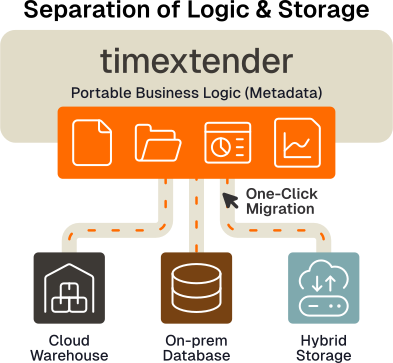 When your business logic is buried in scripts, hand-built pipelines, proprietary services, or one-off tools, you can own the data outright and still not really control it. Moving it, explaining it, auditing it, reusing it somewhere else, all of that gets hard.
Capture the logic, lineage, rules, and documentation as metadata instead, and control starts to travel.
-
The same definitions can move across deployment models.
-
The same logic can be reused across environments.
-
The same lineage can support audit and investigation.
-
The same quality rules can support analytics, AI, and compliance.
-
The same evidence can support internal governance, customer assurance, and regulatory review.
This is where metadata quietly becomes part of the sovereignty architecture.
Not because it replaces cloud, on-premises, or hybrid choices. But because it makes those choices operationally real.
The real test of sovereignty is portability with proof
Every sovereignty claim should have to pass two tests:
-
The first is movement: Can you pick up data, workloads, logic, lineage, governance rules, and AI patterns and run them somewhere else without rebuilding the business from the studs?
-
The second is proof: Can you show where the data came from, what happened to it, who saw it, which rules fired, where it was processed, which model or system used it, and what came out the other end?
Portability without proof is flexibility without trust. Proof without portability is compliance without strategic freedom.
Reduce this whole thing to where the data centre is physically located, and you’ve answered one part of the question while skipping the rest. A genuinely sovereign architecture holds control across all of it: the data, the metadata, the business logic, the infrastructure, the processing, the way AI gets used, and the way out.
What technology leaders should ask now
The organisations that come out ahead won’t be the ones that default to the most locked-down architecture they can find. They’ll be the ones that understand their own control requirements and keep their options open. If you want a structured way to see where your foundation stands today, that’s what an AI-readiness review is for.
 Some workloads belong in public cloud. Some belong in a sovereign cloud. Some belong on-premises. Some will need to move as regulation, customers, commercial terms, or geopolitics shift under you.
The common thread was never a particular piece of infrastructure. It’s control:
- Control over where data lives.
- Control over where processing happens.
- Control over how AI uses business context.
- Control over metadata and lineage.
- Control over business logic.
- Control over portability.
- Control over evidence.
- Control over exit.
That’s what true sovereignty actually means.
Not isolation. Not nationalism. Not turning your back on global technology.
It’s a leadership decision, backed by architecture you can move and evidence you can produce. It was never about choosing sides. It’s about keeping the choice.