The EU AI Act deadline moved.
US companies are in scope.
Whether they know it or not.
You don't need a European office to be in scope. If you sell into the EU, have EU customers, or make decisions about EU residents, the Act applies to you, regardless of where your servers are. And the part of it that should concern you most was never about the model. It's about the data underneath it.
Most organizations are preparing at the wrong layer
The instinct is to reach for a model registry and a risk-rating workflow. Both sit on top of the thing the Act actually scrutinizes. Read Article 10 and the picture changes: the obligations that bite are about provenance, quality, traceability, and the ability to explain where an answer came from.
Those are properties of your data foundation, not your model. Prepare at the model layer and you can pass every governance checkbox and still fail the one that matters under audit.
The same gap that's stalling your AI
Here's what should reframe the budget conversation. The foundation the Act demands is the same foundation that decides whether your AI works at all. Most pilots don't stall because the model is wrong — they stall because it's pointed at data the organization can't vouch for.
Ask it what revenue was last quarter, get four confident, conflicting answers, and leadership quietly loses faith. Compliance pressure and stalled pilots are one problem viewed from two angles. One governed foundation solves both.
Turn "are we ready?" into a plan
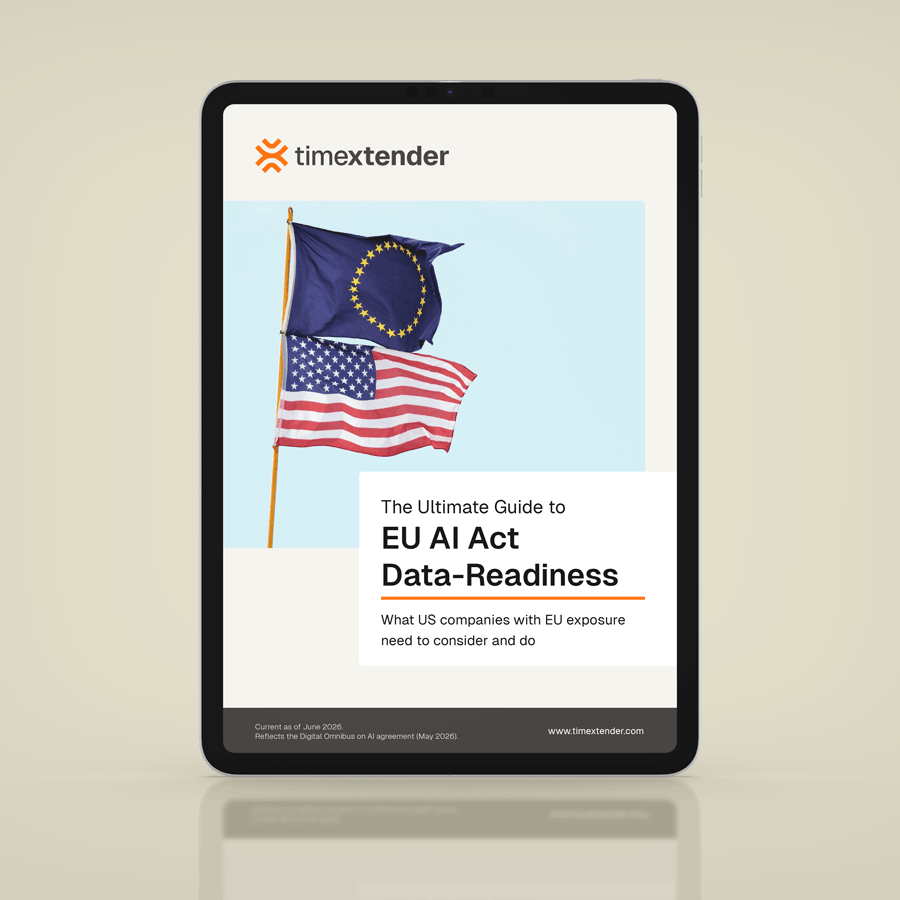
The guide gives you the eight-pillar diagnostic that converts an anxious yes/no into a 90-day plan with named gaps — plus what an AI-ready foundation looks like in practice, and a board-ready action sequence you can take upstairs on Monday. It's a point of view written for the people who answer for AI, not a restatement of the regulation you can find for free.
The post-Omnibus timeline and what moved.
How to determine whether you're in scope, and the 4 triggers that put US companies under the Act.
Why Article 10 makes this a data-governance problem.
The 8-pillar AI-readiness diagnostic, and where most firms score.
What a metadata-driven, automation-first, zero-retention foundation looks like.
A ninety-day action plan for the next quarter.
A professional-services firm built a data factory where every source is "connected, catalogued, modelled, transferred and documented for analysis and AI" — almost a word-for-word description of what Article 10 asks you to be able to show. — Baker Tilly
Prefer to start with your score?
Answer 8 quick questions and get a personal AI-readiness score, plus the three biggest gaps standing between you and production AI.
About Timextender
Timextender offers the Timextender Data Platform, a unified platform with four modules: Data Integration, Data Enrichment, Data Quality, and Orchestration. The modules operate independently today as standalone products, and we are actively unifying them into a cohesive web app, eventually connected by shared metadata across the platform.
Timextender helps teams build AI-ready data using metadata-driven automation across any data source, while supporting deployment across cloud, hybrid, or on-prem environments.