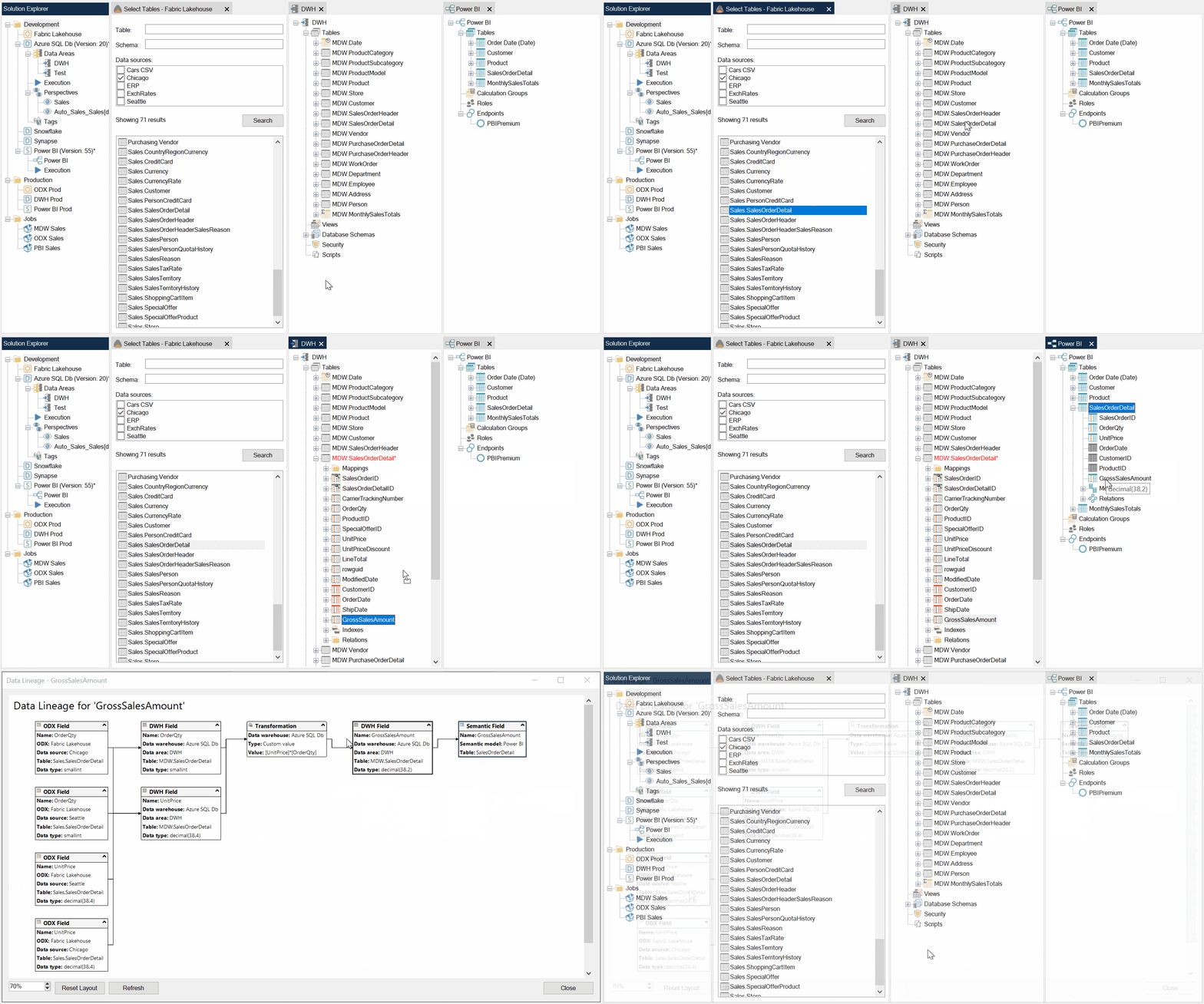

Build an AI-Ready Data Foundation with 3 Modular Layers
By using metadata to unify each layer of your data infrastructure and automate the work that typically requires manual coding, TimeXtender Data Integration helps you ingest, prepare, and deliver AI-ready data up to 10x faster, while reducing operational costs by 70–80%. Our metadata-driven approach and cloud-based instances give you the freedom to build each layer independently or deploy all three together as a complete, integrated data solution.
Ingest Your Data
The Ingest layer is where TimeXtender Data Integration consolidates raw data from disconnected sources into one centralized data lake or lakehouse. This raw data is commonly used for data science and AI use cases, such as training machine learning models or powering advanced analytics.
Universal Data Connectivity:
Connect to and ingest data from our directory of pre-built, fully-managed data connectors, with support for any custom data source. This includes SaaS applications, file formats, REST APIs, OData, cloud and on-premises databases, ERP systems like SAP, and custom or proprietary systems.
Automate Ingestion Tasks:
Define the scope (which tables) and frequency (the schedule) of data transfers for each source. By learning from past executions, the Ingest layer automatically sets up and maintains object dependencies, optimizes data loading, and orchestrates tasks, with no manual intervention required.
Accelerate Transfers with Incremental Load:
Load only newly created or modified data instead of reprocessing entire datasets. Smaller transfers mean faster ingestion, shorter validation cycles, and significantly reduced processing times.
No More Broken Pipelines:
Whenever a change occurs in your data sources or systems, such as a schema update, a new field, or a renamed table, TimeXtender propagates those changes across your entire data environment in just a few clicks. No more manually debugging broken pipelines or chasing down failed jobs.
Prepare Your Data
The Prepare layer is where raw data becomes a single version of truth. TimeXtender cleanses, validates, enriches, transforms, and models data inside your data warehouse or lakehouse, producing a structured, reliable foundation ready for AI, analytics, and BI.
Turn Raw Data Into a Single Version of Truth:
Select raw data from the Ingest layer, cleanse and validate it, apply enrichments, and execute transformations. Once complete, map the data into dimensional models that serve as your organization’s authoritative source for AI and reporting.
Powerful Transformations with Minimal Coding:
From simple field-level adjustments to complex calculations across multiple tables, TimeXtender handles it all inside an intuitive, drag-and-drop interface. Our deterministic, rule-based AI generates production code automatically based on your metadata, minimizing errors and dramatically accelerating the transformation process. Conditions, Data Selection Rules, and custom code are available when you need them.
A Modern Approach to Data Modeling:
TimeXtender’s data warehouse and lakehouse model starts with a dimensional foundation and extends it with additional tables and fields that give data consumers and AI models the context they need. The result is a model that is easier to understand, answers more questions, and adapts to change without requiring a rebuild from scratch.
Deliver Your Data
The Deliver layer, also called the Semantic Layer, gives your entire organization a simplified, consistent, and business-friendly view of all available data products. It maximizes data discovery, minimizes AI hallucinations, and aligns technical and non-technical teams around a shared data language.
Maximize Data Usability with a Semantic Layer:
The Semantic Layer translates the technical structure of your dimensional model (fact tables, dimension tables, foreign keys) into plain business terms like “revenue,” “product,” or “region.” This makes data accessible to every user regardless of their technical background, and ensures AI models have the context they need to produce accurate, meaningful outputs.
Increase Agility with Data Products:
Create department-specific or purpose-specific data products (sometimes called data marts) that deliver only the relevant subset of data each business unit needs. Sales gets their data. Finance gets theirs. No one has to wade through the entire warehouse to find what they are looking for.
Deploy to Your Choice of Visualization Tools:
Data products can be deployed directly to Power BI, Tableau, Qlik, or exported as CSV. Because data products are defined inside TimeXtender, the fields and figures remain consistent regardless of which visualization tool your teams use. This “headless” approach to BI strengthens governance, ensures data quality, and guarantees that every dashboard reflects the same version of truth.
TimeXtender Data Integration Empowers your whole Data Team
Data Users
An intuitive, low-code environment for data transformation and modeling. No deep technical expertise required.
Learn More →
Data Movers
Metadata-driven automation that handles the heavy lifting of data pipeline management, so data engineers can focus on what moves the business forward.
Learn More →
Data Leaders
Fast, governed access to AI-ready data, giving analytics and business leaders the confidence to make decisions and approve AI initiatives.
Learn More →
Frequently Asked Questions
-
What is TimeXtender Data Integration?
TimeXtender Data Integration is a metadata-driven tool that helps you build an AI-ready data foundation up to 10x faster. It
automates the Ingest, Prepare, and Deliver layers of your data infrastructure, eliminating the need for manual coding,
reducing operational costs by 70–80%, and ensuring your data is clean, governed, and ready to support AI and analytics
use cases. An intuitive, low-code interface makes it accessible to teams of varying technical skill levels. -
How does TimeXtender Data Integration accelerate data processes?
TimeXtender uses metadata and deterministic, rule-based AI to automate code generation across your entire data lifecycle.
Rather than writing ETL code by hand, your team defines what needs to happen and TimeXtender generates productionready code automatically, consistently, reliably, and optimized for your chosen storage platform. End-to-end orchestration,
automated data lineage, and intelligent dependency management eliminate the manual work that slows most data teams
down. The result is data infrastructure that goes from concept to production up to 10x faster, with significantly lower
operational costs. -
What cloud data platforms does TimeXtender Data Integration support?
TimeXtender’s technology-agnostic approach supports deployment to a range of storage platforms, including Microsoft
Azure, Microsoft Fabric, Microsoft SQL Server, Snowflake, and AWS. Because our Unified Metadata Framework separates
business logic from the underlying storage layer, you can migrate your entire data solution to a different platform with a
single click. No rebuilds. No vendor lock-in. -
What data sources can TimeXtender Data Integration connect to?
TimeXtender connects to any data source through a comprehensive directory of pre-built, fully-managed connectors, with
additional support for custom sources. This includes:-
SaaS Applications — Salesforce, HubSpot, Google Analytics, Facebook, and many more.
-
Files — Delta Parquet, JSON, XML, CSV, and Excel.
-
APIs — REST APIs and OData.
-
Cloud or On-Premises Databases — Snowflake, SQL Server, Synapse, Amazon Redshift, Google BigQuery, Oracle, DB2, Access, and others.
-
ERP Systems — SAP and comparable platforms.
-
Custom Data Sources — Any proprietary or custom-built system
-
-
What business intelligence and visualization tools does TimeXtender Data Integration support?
TimeXtender supports delivery to Power BI, Tableau, and Qlik, as well as CSV export for flexible data consumption.
Semantic models are defined inside TimeXtender, which means every visualization tool your teams use will always surface
consistent fields and figures; a single version of truth, regardless of the front end. -
How does TimeXtender Data Integration handle changes in data sources, such as schema or API changes?
Whenever a change occurs in your data sources or systems, TimeXtender lets you propagate that change across your
entire data environment in just a few clicks. Our Unified Metadata Framework tracks every dependency, so updates flow
through automatically, rather than triggering a manual debugging session. -
What is the Semantic Layer?
The Semantic Layer is the Deliver layer of TimeXtender Data Integration. It acts as a bridge between the technical structure
of your data model and the end users, both human and AI, who consume it. By translating fact tables, dimension tables,
and complex joins into plain business language, it ensures that every user, regardless of technical skill, can find,
understand, and trust the data they need. The Semantic Layer also serves as a centralized catalog for all your data
products, making data discovery straightforward across your entire organization. -
What does “zero-access security” mean?
TimeXtender orchestrates all data processes using metadata. We never access, move, or store your actual data. Every
process runs inside your own secure environment; your cloud tenant, your on-prem infrastructure, your rules. This zeroaccess model makes security audits, GDPR compliance, HIPAA compliance, and risk management substantially simpler, and
it is why TimeXtender is trusted in highly regulated industries like manufacturing, financial services, and government.